

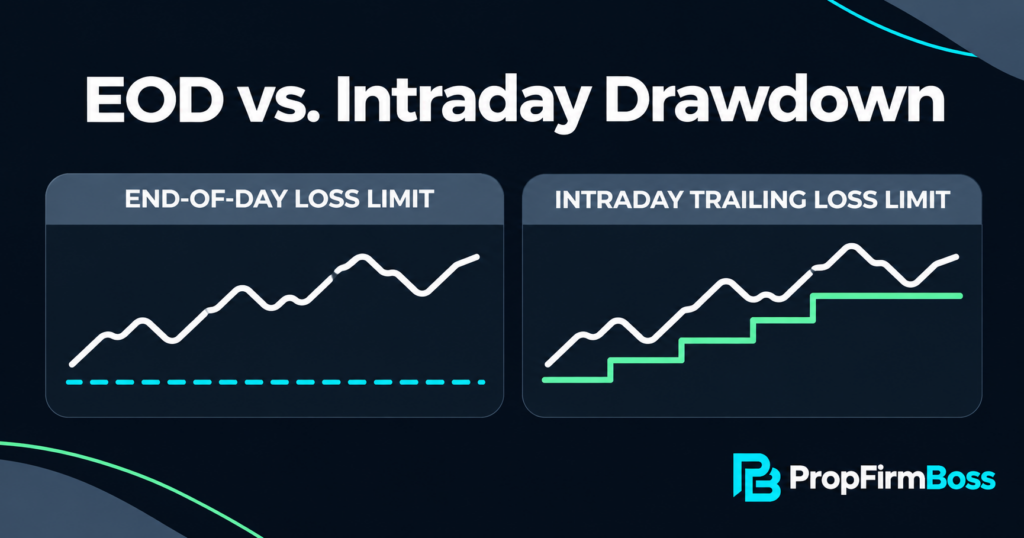
An end-of-day (EOD) loss limit can rise at the firm’s daily cutoff when the account sets a new closing high. An intraday trailing loss limit can rise during the session as account equity reaches new highs. If the intraday calculation includes unrealized profits, an open trade can raise your limit before you exit.
The timing matters because the same trade can breach an intraday trailing limit while staying within an EOD limit. Here’s how that happens on a hypothetical $50,000 futures evaluation.
What is a maximum loss limit?
The maximum loss limit is the account value that triggers a breach under the plan’s rules. On a $50,000 evaluation with a $2,000 drawdown allowance, the starting limit is $48,000. As the account reaches new highs under the plan’s rules, the limit can move up. When profits fall back, the limit stays where it is.
To find how much room you have left, subtract the current limit from your equity. If your equity is $50,000 and your limit is $49,500, you have $500 of room before touching it.
EOD loss limit vs. intraday trailing drawdown on the same trade
Both accounts start the session at $50,000, with a $48,000 maximum loss limit. The EOD plan uses the highest balance recorded at the daily cutoff. The intraday plan uses peak equity, including open profit. In this example, touching the limit triggers a breach.
| What happens | Account equity | End-of-day loss limit | Intraday trailing loss limit |
|---|---|---|---|
| You start the session | $50,000 | $48,000 | $48,000 |
| Your open trade is up $1,500 | $51,500 | $48,000 | $49,500 |
| The trade reverses and equity touches $49,500 | $49,500 | $48,000 | $49,500 (breach) |
At the open-profit peak, the intraday trailing loss limit rises to $49,500 ($51,500 minus $2,000). The trade then gives back its $1,500 open profit and moves another $500 against you. Your equity touches the new limit, so the intraday account breaches. At that same moment, the EOD account still has $1,500 of room above its $48,000 limit.
If the EOD account later finishes the session at $50,600, a new closing high, its loss limit rises to $48,600 at the cutoff. The calculation uses the $50,600 closing balance.
Which futures prop firms use EOD or intraday trailing drawdown?
The table covers specific evaluation and simulated funded accounts. Check the exact plan name when you compare firms. Apex, for example, offers separate EOD and Intraday paths.
| Firm and plan | Evaluation | Simulated funded account | Official rules |
|---|---|---|---|
| Topstep — Trading Combine → Express Funded Account | EOD loss limit | EOD loss limit until it locks at $0. The first payout also sets it to $0. | Maximum Loss Limit |
| FTMO Futures — Growth and Pro | EOD loss limit | EOD loss limit | Futures comparison table |
| Apex Trader Funding — EOD path | EOD loss limit | EOD loss limit in the EOD Performance Account | Evaluation · Performance Account |
| Apex Trader Funding — Intraday path | Intraday trailing loss limit | Intraday trailing loss limit in the Intraday Performance Account | Evaluation · Performance Account |
| My Funded Futures — Rapid 100K | EOD loss limit | Intraday trailing loss limit | Rapid 100K rules |
| Blue Guardian Futures — Zero | Choose EOD or intraday trailing at checkout | Intraday trailing loss limit with either evaluation choice | Zero account rules |
Official rules checked November 17, 2026. Lock levels and payout adjustments depend on the program.
Can you breach an EOD loss limit during the day?
Yes, if your firm enforces the limit intraday. The daily cutoff determines when the limit can rise. The enforcement rule determines when touching it can breach the account. Topstep, for example, updates its Maximum Loss Limit at the end of the trading day and monitors realized and unrealized P&L during the session. Topstep’s Maximum Loss Limit rules
How does static drawdown compare?
A static drawdown keeps the account’s minimum allowable value fixed. In our example, a static limit of $48,000 would stay there through both the $51,500 open-profit peak and the $50,600 session close.
What to check before choosing a futures evaluation
- What moves the limit? Check whether the firm uses the closing balance, the realized balance, or equity including open trades.
- When is the limit enforced? Check what happens if equity touches it during the session and when the firm’s daily cutoff occurs.
- Does the limit lock? Check whether it stops moving at a set balance and what happens after a payout.
- Do the rules change after passing? Check the funded account rules separately. A plan can use an EOD loss limit in evaluation and switch to intraday trailing once you pass.
Two plans can advertise the same $2,000 drawdown allowance and give you different room to manage the same open trade. Open Compare Programs on PropFirmBoss to see when each account’s loss limit moves and when the firm enforces it.